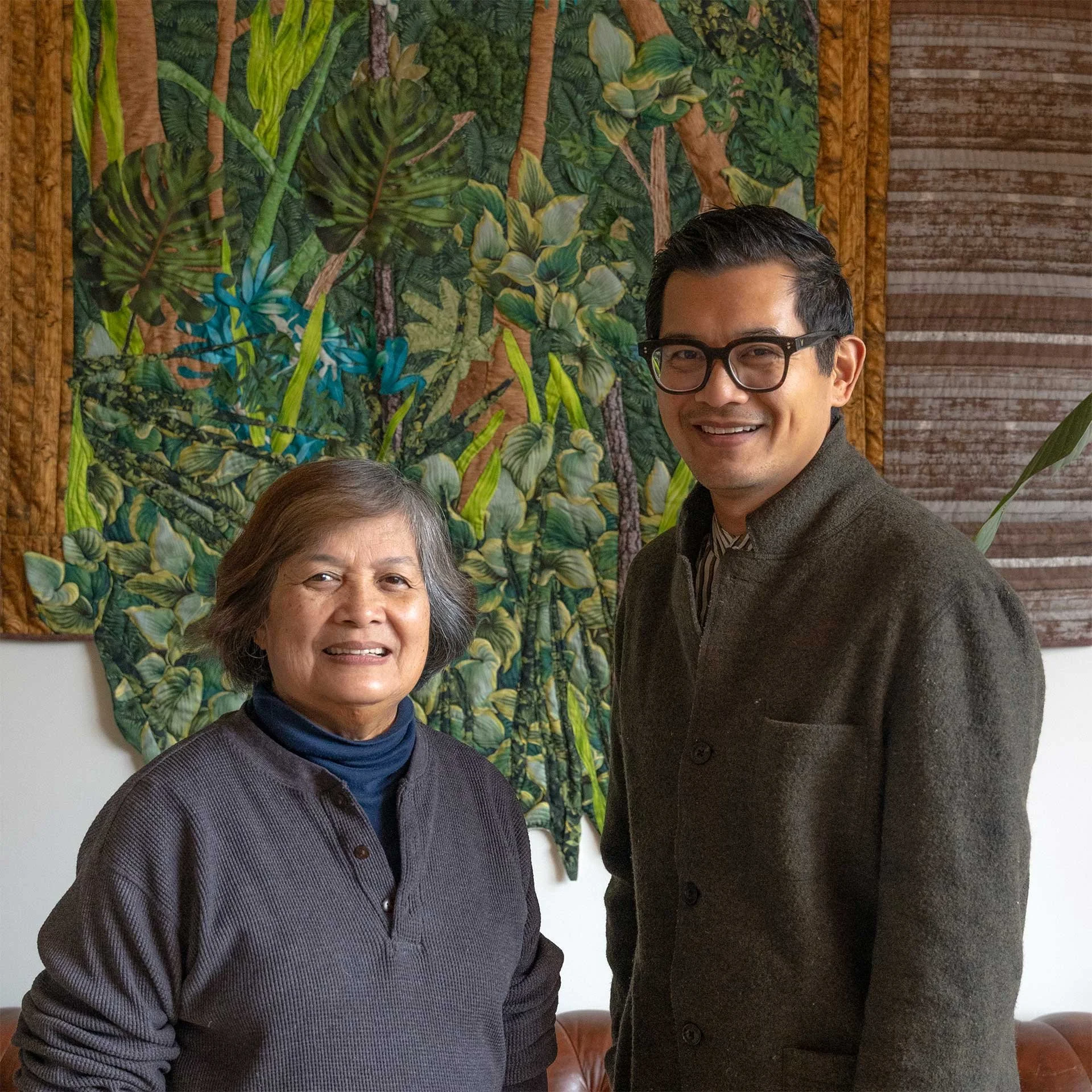
May Gaspay and Mik Gaspay. Photo by Amanda Luu.
May Gaspay
& Mik Gaspay
Residency:
November - December, 2025
Exhibition:
January 17 - 31, 2026
Exhibition Warehouse, 1201 Minnesota Street
Location:
Exhibition Warehouse, 1201 Minnesota Street
Exhibition Warehouse Hours:
Thursdays* & Fridays, 3-7pm
Saturdays, 12-6pm
*Extended hours on Thursday, January 22, 7-9pm
Minnesota Street Project Foundation is pleased to welcome Bay Area artists May Gaspay and Mik Gaspay to the Warehouse Residency program.
Mother-and-son artist duo May Gaspay and Mik Gaspay established their collaborative art practice in 2020. Combining May’s more than forty years of experience engaging traditional quilting techniques with Mik’s conceptual training, the artists create large-scale quilted works and installations that reflect sites and objects of personal, familial, and cultural significance. Their joint practice began as a way to work through ideas of home and loss after the 2019 typhoon destroyed May’s childhood home in Enrile, Cagayan, in the Philippines. The pair has since continued to navigate the entangled layers of memory, migration, and family history as a means of connecting with each other and those around them. Exploring quilting as care, their work transforms fabric into vessels for storytelling to create a soft archive that preserves and reinterprets intergenerational experiences.
For the Warehouse Residency, May and Mik are realizing a new body of work, expanding their ongoing exploration into family histories to include extended family. The installation, Ong's Boat, honors and memorializes the lived experience of Mik's father-in-law, who fled Vietnam at age 14 with his brothers. For the artists, creating a visual record of this recently surfaced story is a way of preserving family history so that it can be passed down across generations.
Mother-and-son artist duo May Gaspay (b. 1953, Cagayan, Philippines; lives in Palo Alto, CA) and Mik Gaspay (b. 1976, Quezon City, Philippines; lives in Kensington, CA) established their collaborative practice in 2020. Reflecting sites and objects of personal and cultural significance, their large-scale quilted works and installations explore memory, migration, and family histories. Transforming fabric into vessels for storytelling, they translate inherited and shared narratives in an act of preservation and care.